The most time consuming, expensive, and soul crushing part of my PhD applications was…you guessed it! The GRE. While I am eagerly waiting for the day standardized tests are completely discarded as part of any application process, I still wanted to share my experience to let you know that you’re #MoreThanNumbers.*
As someone who used to work in college access, I can confidently say that standardized tests suck. Plenty of people have already written articles on why tests such as the SAT and GRE perpetuate inequity and racism. And while I could probably do a whole post on why standardized tests are useless, that’s not the point of this one.
Like most people (unless you’re miraculously gifted), the GRE was not my friend. Statistically, I am supposed to perform well on this test. And while I think I scored okay on the Verbal and Analytical Writing sections, my Quantitative section was truly dreadful.
My Scores
I know this is the part you’re probably most curious about, so let me put it out there now. I took the GRE twice and ended up with the following scores:
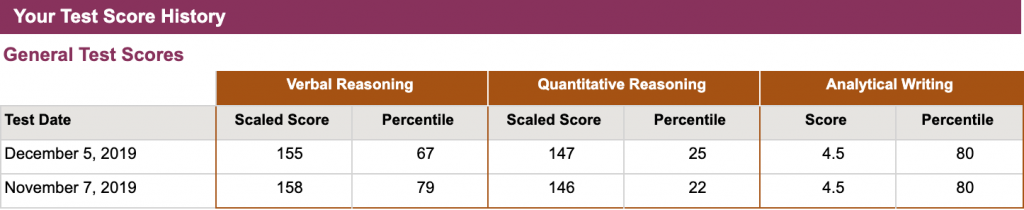
GRE General Test I
November 7th, 2019
Verbal: 158 | 79 percentile
Quantitative Reasoning: 146 | 22 percentile
Analytical Writing: 4.5 | 80 percentile
GRE General Test II
December 5th, 2019
Verbal: 155 | 67 percentile
Quantitative Reasoning: 147 | 25 percentile
Analytical Writing: 4.5 | 80 percentile
Let’s break down my scores a little bit more. It’s clear that Verbal Reasoning and Analytical Writing were my stronger sections. The first time I took the test, I was actually shocked at my Verbal score. I scored a 152 on my first diagnostic test, and had only been getting around a 154 on follow up tests. The fact that it jumped 6 points was pleasantly surprising. According to PrepScholar, boosting my score that many points meant I likely needed to have spent upwards of 4o+ hours of good studying. I can assure you, this definitely didn’t happen.
My Quantitative Reasoning scores, however, were much more disappointing. On my diagnostic test, I scored a 149. So, I set a goal to break the 150 threshold. At the time, I thought it seemed reasonable enough to boost my score one measly point. I thought, if anything, I would at least score a 149. Nope. As pleasantly surprised as I was with my Verbal score, I was horribly surprised by my Quant score. They really like to mess with your head by showing you your scores and percentiles immediately after sitting for a 4 hour test.
My Decision to Re-take
The 22 percentile? My heart sunk. There was no way any PhD program would want me. In my experience working in hire ed, most programs just say “holistic admissions” for applicants benefits. They don’t actually mean it. I couldn’t even bring myself to say my Quant score out loud — I was so embarrassed. After asking around for advice, I came to the conclusion that I was going to re-take the GRE. I needed to know for sure that those scores were truly the best it was going to get.
So, $205 down the drain again. I went into it with every intention of studying hard every day, but my other responsibilities go the best of me. You see, re-taking the GRE was not in my application timeline. It was November. I should’ve been moving on to my SOP, starting my Literature Review for my Directed Study, and preparing for the conference presentation I was giving in December. Looking back now, I should’ve been more realistic with myself about studying. I knew I probably wasn’t going to study the amount I needed to to significantly boost my scores.
I truly thought I’d scored better on both the Verbal and Quant sections when I took the test for the second time. My second section of Quant was harder, so I felt pretty confident. To my dismay, my Verbal score went down and my Quant score only went up by one point. How did this happen?
“It is what it is.”
As disappointed as I was, I knew that I could not sit through the GRE for a third time, even if it was a year later. I was done with the study sessions, the vocabulary memorization, and trying to figure out all the tricks. I was over it. At a certain point, I pushed back my chair and washed my hands of the test. “It is what it is,” I told my friend. If my scores weren’t enough for these PhD programs, then it looked like I wasn’t going to do a PhD program.
I ended up deciding to stick with my original scores. The slight improvement in my Quant score was not enough to justify sending in the lower Verbal score. They wouldn’t be any more impressed with the 25 percentile than the 22 percentile Quant performance, so I might as well cross my fingers and send in the higher Verbal score.
To be clear, I do not necessarily think my scores were awful. I know that there are plenty of people who might score below me, and I do not want this to discourage you. I just know that all the Reddit and GradCafe threads I was reading were people posting threads like:
“V: 165, Q: 167, disappointed. Should I retake?”

Also, one of the professors I spoke to said that even if an applicant had amazing research experience (I did not), they would still a Quant score in the 60th percentile to be considered. Hearing this on the same day I took the GRE for the second time was really discouraging, and I almost didn’t apply altogether.
#MoreThanNumbers
Given all the stereotypes about Asians and academics, I was initially too scared to share these numbers. The thought of people knowing my stats and potentially thinking “how they heck did she get in?!” was not really something I wanted to invite. It wasn’t until I came across an Instagram post by PhD candidate McKenzie Stokes that I decided to share my information too. S/o to McKenzie for not only inspiring me, but also graciously giving her permission to let me partake in the #MoreThanNumbers challenge as well.
I share this with you today to remind you that you’re more than numbers. You are more than your GPA and GRE scores. My undergrad GPA was 3.58 and my GRE scores were V: 158, Q: 146, and W: 4.5. I had a C and a C+ on my undergrad transcript, too. These are not necessarily amazing statistics for PhD programs, who often only take between 3-10 applicants a year.
But, here I am, about to start my PhD program with full funding a year later. Don’t let the fear of your numbers keep you from going for it. If I made it, you can too!
*I got this idea from future Dr. McKenzie Stokes, who bravely shared her numbers to encourage other people that they are #MoreThanNumbers.
If you have feedback on anything I said, or the way I said it, please let me know. I am still learning and growing. I know that even if I had no intention of being hurtful or harmful in my writing, the impact might be different.
Leave a Reply