After sharing my GRE scores, you may or may not trust me with GRE prep. While I definitely won’t be working as a test prep tutor anytime soon, I did want to offer a few tips about how I studied for the GRE on a budget. I hope you find one of these helpful!
As I mentioned in this post, the GRE was the most expensive component of my PhD applications. Because I’d already spent so much money signing up for the test alone, I knew I couldn’t afford to shell out much more on test prep. So, I turned to the best place I knew for help: the internet.
All of the resources below are ones I found through my online research. I quite literally spent hours figuring out the materials that worked for me, so I hope at least one of these helps inform your studying, even if it’s different than mine.
The 4 Free Resources that Helped Me the Most
1. ETS’ two free practice GRE tests. ETS offers two free practice GRE tests once you’ve created your account. These helped me a lot because they were a) free and b) I could go back and review my answers. I also liked to write down any vocabulary words I wasn’t familiar with to make sure I studied those as well.
2. @GregMat on YouTube. This man is the person I wished I could be when I took the GRE. I found him when I was browsing through Reddit threads, and I’m so thankful I did. While he has a lot of YouTube videos on the GRE (and the GMAT), the videos that helped me the most were his walkthrough videos:
- “GRE Verbal Section Walkthrough: How I take the test (Part 1)” & pt. 2// Because any strategy was better than what I was doing, I straight up copied the way he took the Verbal section. When I switched to his process, I found I had time at the end to review my answers, which I think helped my score in the long run.
- “GRE Quantitative Section Walkthrough: How I take the test (Part I)” & pt. 2// I don’t have much to say about this, because I was trash at Quant either way. But it still helped a lot with timing, even if my answers were all incorrect.
- “Writing the GRE Issue Essay – Step-by-step Guide” & “GRE Argument Essay Step-by-step Guide and Example” //I copied down and memorized his sentence starters, which proved super helpful come test day. I tend to overthink wording, and using his what he’d writted helped me just start writing and get my points across.
@GregMat also has some helpful videos on how to break down the different types of GRE problems that I would highly recommend as well. If you’re short on time, you can always watch the videos at 1.5 x or 2 x speed.
3. “GRE Vocabulary Flashcards” App. I mainly used this app on the bus rides to/from my study sessions. It’s convenience and price ($0) were the main selling points for me. But, if you want another reason, a lot of the words I studied in this deck showed up on the GRE.
Also: I didn’t use Anki, but I imagine there are plenty of GRE vocab decks on there as well.
4. Reddit. I personally love Reddit, but I also stand by my philosophy:
Reddit in moderation is helpful. Reddit in excess is harmful.
This is especially true for applications and standardized testing. A lot of times, reading Reddit threads made me more anxious. If you find yourself going down a rabbit hole, just close out of it. I primarily used it as a starting point for advice on specific subjects. For example, I would type in “Best GRE prep book Reddit” into Google, and glean advice from what other people had to say. Which leads me to my final point.
If you’re able to spend a little money:
5. Test Prep Books & Other Materials. The screenshots you see below are the only GRE prep materials I paid for. According to Reddit (as well as a few other test prep sites), it’s best to practice with problems written by ETS. It can be tempting to buy other materials from companies like Kaplan, but your money is better spent on ETS material because they’re the ones who actually write the test.
- The Official Guide to the GRE was the first book I purchased. It helped a lot by breaking down the format of the test, the different sections, and the concepts being tested on the GRE. It also comes with 4 practice tests!
- 5 lb. Book of GRE Practice Problems was another Reddit find. If you buy this book, Reddit says you should only study the math section. Don’t touch the Verbal practice problems, because apparently they’re written differently than the ETS ones.
- The GRE Vocabulary Flashcards were a good complement to Magoosh’s vocabulary app. I liked to use the flashcards when sitting at my desk, and the app for when I was on the go.
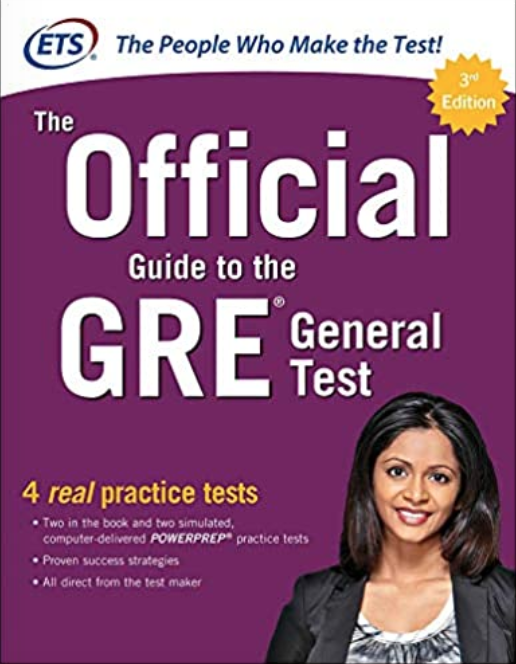
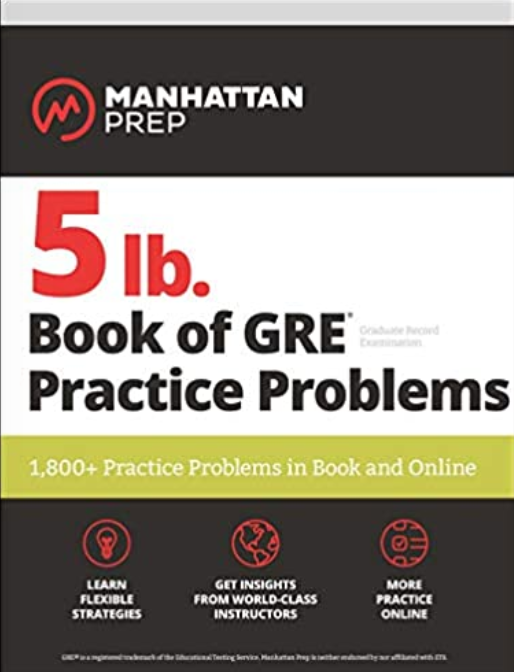
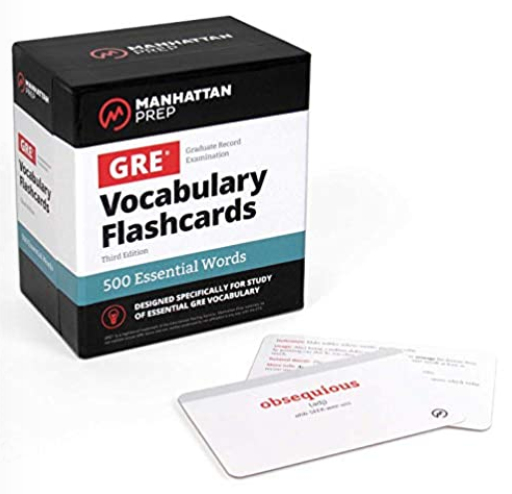
If anyone knows a place other than Amazon to purchase these books, let me know!
Misc. GRE Prep Tips + Thoughts
And because I couldn’t help myself, please enjoy a few more pieces of advice that I have about studying for the GRE.
1. Take a diagnostic test before you start seriously studying or buying test prep material. I only reviewed the structure of the exam and the way it was scored before taking my first practice test. I felt like this gave me a pretty accurate starting point and helped me with my study schedule.
2. Once you have an idea of your starting point, create a study schedule for yourself.
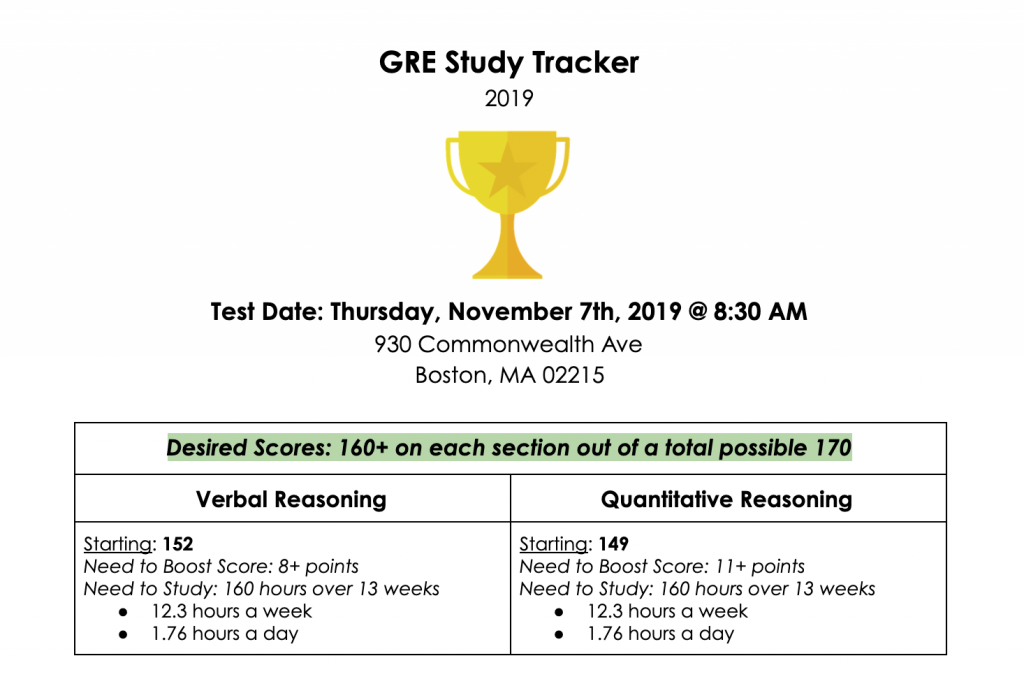
This guide roughly informed the number of study hours I wanted to put in, but there are a lot of other ones out there. I liked breaking down my study goals in this manner, because hearing “160 hours of studying” is overwhelming. But “1.76 hours a day” is more manageable. Remember to give yourself a little bit of wiggle room for the days you will inevitably skip studying or study less than your daily goal.
3. Research program stats. Not all programs publish their GRE stats, so you might have to ask their academic or program coordinator how they consider test scores. While we all obviously want to score as high as possible, it could be that the program you’re applying to doesn’t really weigh Quant scores as much as Verbal and Analytical Writing. This information proves especially helpful if you’re trying to decide whether or not to re-take the GRE.
4. Be brutally honest with yourself about how much you’re actually going to study. If I’d done this, I wouldn’t have re-taken the GRE. I barely studied and it clearly showed in my scores the second time around.
5. Your scores can go down. This sounds scary and disheartening (it was for me), but I write this to prepare you for a worst case scenario. For some reason, I had it in my head that I couldn’t score lower than my first GRE diagnostic test. And then, on test day, I did. I sincerely hope this doesn’t happen to you, but at least you’re one step ahead of me and know it’s a possibility.
And Finally…
6. I would strongly advise against taking the test more than 3 times within a 3-4 month period. This isn’t really based on any scientific data, but I personally don’t think it’s worth it to spend that much time, money, and energy on the GRE. When I was working at a high school, I had a few seniors who took the SAT 3-4 times. Their fee waivers didn’t cover the 4th test, so they ended up paying out of pocket for it. The differences in their scores between the first and second tests were usually the most significant. After the second test, scores didn’t really improve. And in some cases, they actually went down.
If you have the luxury of having a lot of time, money, and energy to spend on the GRE, then go for it. But if your scores don’t significantly improve after retaking it for a second or third time (and you’ve been putting in a lot of study sessions) it’s time to take a break. Or, you can do what I did and just submit your applications with the scores you have.
Remember, your test score does not define you. Research on the ability for GRE scores to predict success in grad school is shaky at best. I think more and more schools are finally coming around to going test optional, or getting rid of test scores altogether.
I hope this post helped you in some way, even if it was to just laugh at how naive I was. Are you taking the GRE this Fall? What are some of your favorite tips?
If you have feedback on anything I said, or the way I said it, please let me know. I am still learning and growing. I know that even if I had no intention of being hurtful or harmful in my writing, the impact might be different.
Leave a Reply